
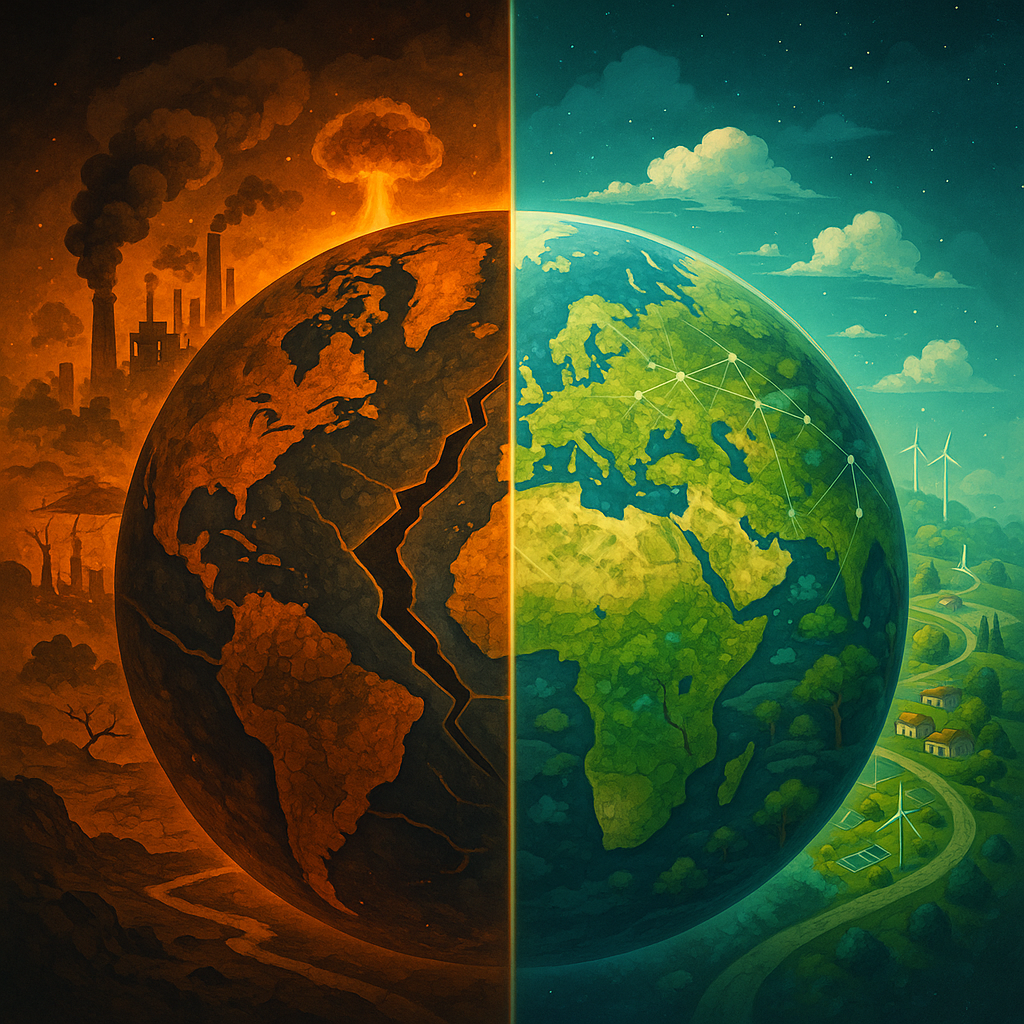
Which Way Are We Going?
The Invisible Filter Shaping Our World and Our Uncertain Future
If you are like most people, you likely don’t realize you are experiencing life through a powerful filter, a mental construct that you didn’t consciously create. At the same time, this construct has pervasively influenced how you experience the world around you and has done so virtually since birth. That filter is called your “self-image.”
Your self-image is not about vanity, confidence, or appearances. It’s the powerful internal blueprint of who you believe you are and how you fit into the world around you. It is the unique collection of beliefs, emotional wounds, stories, and unconscious rules you absorbed about yourself, others, and the world. Many of these you adopted before you were even aware you were learning them.
Your self-image defines the answers to silent questions, such as:
- Am I lovable?
- Am I enough?
- Can I trust others?
- Do I matter?
- Is the world safe?
- What’s possible for someone like me?
Your Self-Image determines how you see the world and what you create in life. It determines what you allow yourself to have or be, how you interpret events, how you relate to others, and what kind of life you believe you are worthy of living.
And here’s what’s key: for the most part, we never consciously create our self-image through conscious choice—we both inherit and adopt its defining components, mostly unconsciously. This lack of self-awareness is at the core of our individual and collective struggles.
OMG, and yet we live our whole lives within its confines.
So…here’s the really interesting aspect of our self-image: What if this process is true on more than an individual level? What if humanity also has a self-image, a deeply embedded, inherited identity that shapes how we see ourselves as a species, and all that entails?
To Understand more about how we are effected by our childhood, and how it defines us in life, check out this post – “Childhood’s Hidden Influence: Unlock Your Future By Understanding Your Past” which you can find HERE
From Personal to Collective: Humanity’s Self-Image and Spirituality on

And what if that outdated collective self-image is the real reason we keep repeating the same destructive cycles, despite all our progress in other key areas, such as longevity or on the technological front, including artificial intelligence?
An identity passed down through generations, forged in history, conflict, and survival, one that defines who we (think we) are: creative yet separate, flawed and violent, divided and often believing ourselves superior to nature and each other. This pessimism about human nature has become a self-fulfilling prophecy.
Just like we do as individuals, humanity becomes what it believes itself to be, and it also acts within the confines of our collective self-image. Our morals and values stem from this underlying framework.
Unfortunately, as it is for us individually, unless we collectively and consciously rewrite this blindly accepted story of who we are, we will unconsciously continue patterns that could ultimately destroy everything we’ve built. With our current technological capabilities and the looming climate crisis, this could threaten the extinction of humanity itself.
I think Humanity’s self-image is in dire need of an upgrade! And soon! Our collective future depends on it.
The Inherited Self-Image of Humanity: Our Collective Blueprint
In a similar fashion to where we all inherit traits, beliefs, and emotional patterns from various sources, so does humanity. Our cultural inheritance includes more than language and customs—it includes our collective identity and sense of what it means to be human, including our spirituality or lack thereof.

For far too many centuries, we have absorbed and blindly accepted stories that we are competitors, conquerors, separate from each other and nature. That different races, cultures, and nations need to be viewed through lenses of comparison and judgment rather than connection. These narratives are deeply embedded in our religions, politics, the various forms of media, and economies. Based on historical precedent, they’re rarely, if ever, questioned, and instead, they are unconsciously passed on from generation to generation.
We see this identity playing out in:
- Racial, political, and economic polarization
- Justifications for war and domination
- Economic systems that often reward exploitation over cooperation
- Media that thrives on fear, outrage, and conflict
- Cultural myths that celebrate power and control over empathy
- Environmental practices that treat the planet as a resource rather than a living system
This inherited identity keeps us locked in cycles of blame, judgment, violence, war, and emotional immaturity. It teaches us to fear the “other,” to externalize our pain, and to seek control rather than connection, focusing on differences rather than commonalities and solutions. The suffering of others becomes normalized, and society as a whole suffers.
The Historical Roots: How Our Collective Self-Image Formed

Both our individual and humanity’s early identity were forged based on our primal survival needs and impulses. Scarcity, threats, and violence shaped our early civilizations. Power became the currency of safety. Control was confused with order. Differences are far too often seen as dangers or threats, instead of inspiration to find a better or more evolved way of being.
These survival-driven mindsets gradually hardened into ideologies and social structures. Patriarchy, colonialism, racism, and religious supremacy became normalized parts of the human story, narratives that still define many people’s understanding of “the way things are.” The history of ideas shows how these concepts became entrenched.
As Friedrich Nietzsche observed, humanity often creates meaning through power structures that ultimately cause a great deal of harm. The ugliness and brutality of these systems have shaped human life throughout history.
At the same time, alongside these darker patterns, we humans have also demonstrated a remarkable capacity for cooperation, innovation, and compassion, especially in times of need. Early humans survived through collaboration. Indigenous cultures worldwide developed sophisticated systems of ecological stewardship. Throughout history, movements for justice and liberation have continually emerged, demonstrating our innate desire for fairness and connection. Human beings are capable of both extreme cruelty and extraordinary kindness.
Our collective self-image contains both our destructive and constructive elements. Meanwhile, our institutions and systems have often amplified the former while undervaluing the latter.
The key insight here is that these stories, both constructive and destructive, are not immutable truths. They are simply inherited scripts. Unfortunately, left unexamined and unupdated, they sadly and dangerously perpetuate themselves and become destiny. We must disrupt these patterns to survive the next phase of our evolution.
To get your thinking, check out this article”The Power of Humanity: On Being Human Now and in the Future” which you can find HERE
Hierarchies and Division: How We Learned Separation
One of the most destructive elements of humanity’s inherited self-image is the belief in unequal human worth.
Throughout humanity’s history, societies were built on rigid hierarchies: kings over peasants, clergy over commoners, landowners over laborers. This wasn’t just social structure; it became identity, a way of understanding one’s place in the world. Control of the means of production determines one’s status and options in life.

This pattern continues today in various forms across cultures:
- The wealthy are often seen as more capable or deserving, especially in their eyes.
- Corporate elites are praised, while essential workers are frequently overlooked or minimized.
- Education systems in many countries still emphasize compliance over creativity and are structured to treat the privileged differently.
- Children in low-income families worldwide often inherit limiting beliefs about what’s possible that become the foundation of their self-image, guaranteeing that their place in the social structure is perpetuated.
As Robert Kiyosaki noted in “Rich Dad, Poor Dad,” the beliefs we absorb about money, success, and worth define our paths. Children in wealthy families often learn an ownership mentality in the comfort of abundance. Children in poverty frequently inherit limiting beliefs. Both perspectives become wired into neural pathways and self-image.
The North American education system, modeled partly on industrial needs, was designed to create a predictable workforce. Similar patterns exist globally, where educational systems often neglect key components of human development such as financial literacy, self-awareness, and emotional intelligence, the very tools that enable personal sovereignty and a high standard of living.
This isn’t just inequality; it’s about the psychological conditioning that limits human potential on a massive scale.
When people believe they are lesser, they will live as though this is true and it is written in stone. The same applies to humanity, when we collectively believe human nature is inherently selfish and violent, we create systems that reflect and reinforce that belief.
Modern Reinforcement: How Today’s World Maintains the Old Story

The world today continues to reflect and reinforce our outdated collective story:
- Political and economic systems often thrive on division, exploiting perceived weaknesses to create separation
- Much mainstream media monetizes fear and outrage rather than understanding and solution-finding
- Social media algorithms frequently elevate conflict-driven content over constructive dialogue
- Consumer culture encourages distraction and instant gratification over reflection and growth
- Artificial intelligence, if developed with our current mindset, risks amplifying our worst tendencies
We have built a digital civilization on top of an emotional foundation that hasn’t evolved at the same pace as our technology. Instead of using our unprecedented connectivity to elevate human consciousness, many systems operate based on outdated paradigms of separation, scarcity, and fear.
Our Amazing Better Side

Yet alongside these patterns, we see powerful counter-movements emerging globally:
- Collaborative platforms enabling strangers to share resources and solve problems together
- Indigenous wisdom traditions are gaining renewed respect for their sustainable worldviews
- Grassroots initiatives are building bridges across seemingly insurmountable cultural divides
- New economic models prioritizing well-being over unlimited growth
These examples show that our collective self-image is not fixed; it’s evolving, albeit unevenly. They give us faith in humanity despite the current state of affairs.
The Dangerous Paradox: Advanced Tools, Outdated Identity
Now, both collectively and individually, we face a dangerous paradox:
We have developed god-like tools—nuclear weapons, artificial intelligence, planet-scale communication networks—while operating with the emotional maturity of a species still carrying unhealed trauma and outdated beliefs about who we are.

Take the United States: conceived as a symbol of freedom and opportunity, it now experiences intense polarization under competing visions of national identity. But this pattern isn’t unique to America—from Brexit to ethnic conflicts worldwide, we see similar challenging identity concerns play out globally.
What we’re witnessing isn’t just political unrest—it’s an identity crisis on a planetary scale. A fractured collective self-image played out across continents. Climate scientists warn that without transformation, we face catastrophic outcomes by 2050 or the end of the century.
And critically, our advanced technologies and weapons of mass destruction mean we cannot survive this transition with our old story intact. Unlike previous eras, the stakes of our identity crisis are existential. We can no longer turn a blind eye to the consequences of continued adherence to outdated beliefs.
The Psychological Cost of Our Broken Collective Self-Image
A distorted collective self-image leads to:
- Blame instead of responsibility
- Judgment instead of empathy
- Disconnection instead of cooperation
- Exploitation instead of stewardship
- Reaction instead of conscious creation
- Harm to others instead of connection with others
We project our inner wounds outward, demonizing those who seem different. We numb ourselves through various means, from substance addictions to social media dopamine hits, instead of growing into our fuller potential as a species. In extreme cases, this disconnection can lead to a narcissistic mindset or even a mental breakdown in individuals who cannot reconcile their inner and outer worlds.
Moreover, we do all this largely unconsciously, as if this is the only way, that there’s no alternative way of being human. This collective blindness to our accepted patterns mirrors exactly how individual self-image operates: invisibly determining our choices while creating the illusion that “this is just how things are.”
A New Possibility: Reimagining Humanity’s Self-Image

I’m here to tell you that there is a better way, one where not only do we survive, but we thrive and become something we can be collectively proud of. History shows that humans are capable of remarkable transformation when truly necessary. We can create a utopian future if we choose to see the humanity in each other.
Imagine if humanity saw itself as:
- Self-Responsible: We take full responsibility for our upsets and see them as a way to grow and evolve. We stop blaming others or taking aggressive actions to get our unmet needs met.
- Stewards, not dominators: Caretakers of ourselves, each other, and the living planet that sustains us
- Collaborators, not just competitors: Partners in creating a world where all can flourish
- Creators, not merely consumers: Active participants in shaping a meaningful future
- Conscious beings: Aware of our patterns and capable of choosing new ones
- Connected, not separate: Part of a single human family and a larger living system
What if our shared collective story is updated from one focused on division, judgment, scarcity, and control to one centered on empathy, responsibility, shared well-being, and creative possibility?
This is not fantasy or naive idealism. Throughout history, humans have demonstrated an extraordinary capacity for cooperation, innovation, and compassion alongside our destructive tendencies. Indigenous cultures worldwide maintained sustainable lifeways for thousands of years. Even today, in disaster situations, people routinely demonstrate remarkable solidarity across social divides.
A new collective self-image will only manifest itself when we choose to amplify the existing positive human capacities rather than blindly accept and follow our destructive patterns. The change will starts with increasing our awareness about the inconsistencies in our current worldview and making a commitment to change course toward something better, getting off the blame-and-control treadmill to find common ground in creating a world where all can thrive.
How We Begin the Upgrade: Practical Steps Forward

To evolve our collective self-image, we must:
- Tell better and more honest stories about who we are and what we are really capable of, in media, education, and throughout culture. Our stories shape reality by shaping perception.
- Raise children differently to break intergenerational cycles of trauma and limitation. This means creating environments that nurture wholeness rather than perpetuating our wounds. (For me, I believe that how many people raise their children is one of the biggest causes of our problems.)
- Heal historical and personal trauma both individually and collectively. Unhealed trauma drives reactive behavior and perpetuates cycles of harm.
- Create systems that reflect wholeness, not hierarchy—redesigning our institutions to embody the values we wish to cultivate. Society’s structures should support the things they value about human life.
- Do our inner work, because conscious individuals uplift the whole. From Gandhi to Mandela to countless unnamed heroes, history shows how transformed individuals help transform society. Be the change you want to see in the world.
As from within, so from without. Our collective reality reflects our collective self-image(s), which is simply the sum of our self-images in relationship with each other. We can fix the problem by starting with ourselves.
Your Role in Humanity’s Self-Image Transformation

The real crisis we face isn’t primarily political, environmental, or economic, though it manifests in all these domains. At its core, it’s a crisis of identity, both individual and collective.
Our future will be shaped by updating what we believe about ourselves as a species. But it will then depend on what actions we then take, and that belief we collectively adopt. We can update our individual and collective trajectory, but it must start with ourselves by taking full self-responsibility.
We are either unconsciously repeating the old story, with its predictable destination of intensifying conflict, or consciously participating in writing a better one. Humanity needs a new narrative that can serve as a powerful catalyst todrive positive change.
The Increasing Demand for the Collective Self-Image Update
Let’s be really clear: Currently, the trajectory we are on is precarious. In our interconnected world with powerful technologies, miscalculations or failures of empathy can have cascading consequences for humanity’s future. This is clearly evidenced in what has been happening in the world, but especially in the U.S. in 2025.
The question is not if we can change. History proves we can. The question is: Will we do it in time?
I ask that you don’t just read this article and put it aside. Right now, humanity’s uncertain future needs more from each of us.

It’s up to all of us to demand something better, from both ourselves, but more importantly, from our collective identity. We humans are capable of so much more; we just need a new collective self-image that focuses on the best of who we are and who we can become.
If you find yourself caught in narratives focused on division, blame, or simplified political identities, remember that the problem is never solely “out there.” The world around us reflects back what needs attention within ourselves. Our reactions to others and to events reveal our own unhealed wounds and limiting beliefs.
True transformation begins with this inner work. As we heal our individual self-images, we contribute to healing our collective self-image. As we become more conscious of our own patterns, we help humanity become more conscious of its patterns.
This is where lasting change will come from. It starts with us recognizing our own pain without passing it on to future generations or projecting it onto others.
Transform Your Self-Image, Transform Your World

Do these ideas resonate with you? Are you ready to explore how your own self-image might be limiting your life—and how transforming it could help transform our collective future?
My upcoming book “Screw My Ego: Breaking Free from the Invisible Prison of Your Self-Image” provides a comprehensive roadmap for identifying and updating the limiting beliefs that shape your reality. In it, you’ll discover powerful tools to:
- Identify the hidden beliefs that have been controlling your life
- Understand how your self-image was formed and why it resists change
- Transform limiting beliefs into empowering ones that support the life you truly want
- Contribute to our collective evolution by becoming more conscious of your patterns
Because when we change our self-image, we change everything.
When Humanity Changes and Upgrades its Self-Image,
Everything changes!
Thanks for Reading,
Remember to Be Good to yourself! Love yourself a bit more today!.
Leave a Reply
You must be logged in to post a comment.